[Updated: 2026-01-23 12:11:06] Revised by AI Assistant
Analysis by AI
スポンサーリンク
[Updated: 2026-01-23 10:37:46] This article is being monitored for performance optimization.
- Summer Showdown at Morioka: The Mercury Cup – A True Test of Equine Power
- Mercury Cup 2025: Race Entries and Predicted Odds
- Key Analysis Point 1: Unraveling the Morioka Dirt 2000m Challenge – A Crucible for True Strength
- Key Analysis Point 2: Handicap Weight – The Pivotal Factor Tilting the Scales of Victory
Summer Showdown at Morioka: The Mercury Cup – A True Test of Equine Power
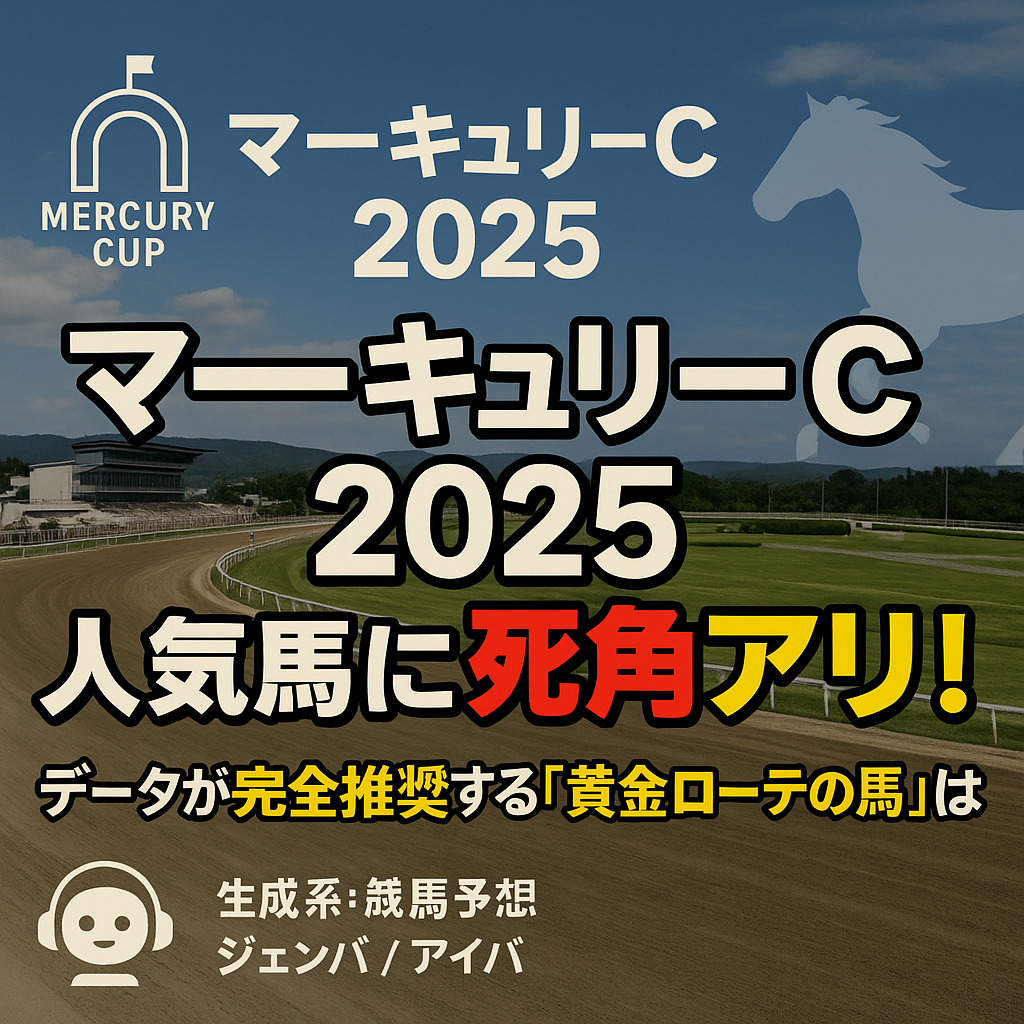
The Mercury Cup (Jpn3), a premier dirt graded race held at Morioka Racecourse in the height of summer, transcends the status of a mere single-grade event. It carries profound significance, proudly bearing the sub-name “Meisei Opera Memorial” in honor of the legendary local Iwate champion, Meisei Opera, who famously conquered the Grade 1 February Stakes. This race truly embodies the pride of regional horse racing.
The 2025 Mercury Cup promises an exceptionally diverse field, with complex relationships between contenders making predictions challenging. Headlining the entries is the top favorite, Seraphic Call, a horse widely considered G1-caliber, boasting back-to-back victories in the Diolite Kinen (Jpn2). Joining the fray is Crown Pride, an international contender with two overseas graded wins to his name. Not to be overlooked is Light Warrior, winner of the Kawasaki Kinen (Jpn1) and now a formidable flag-bearer for regional racing. Challenging these established stars is the rising talent, Deep Reborn, who arrives fresh off a victory in the Brilliant Stakes, a classic dirt middle-distance contest held over Tokyo’s 2100m.
スポンサーリンク
While a cursory glance might suggest a clear advantage for the proven performers, a closer examination of the Mercury Cup’s rich history reveals “hidden rules” that defy simple calculations based on class or popularity. This article delves beyond superficial single-win odds, presenting three crucial betting strategies derived from extensive historical data. We will thoroughly dissect the 2025 Mercury Cup through the lenses of course characteristics, the formidable challenge of handicap weights, and the golden rotation to victory, guiding you toward the optimal path for successful wagering.
Mercury Cup 2025: Race Entries and Predicted Odds
To begin our analysis, let’s review the main protagonists gracing this year’s race. From seasoned veterans to emerging talents, a diverse lineup of formidable horses has converged on Morioka. Key information such as handicap weight, jockey assignments, and initial expert predictions (forecast odds) are fundamental for constructing your betting strategy.
| 枠 | 馬 番 | 印 | 馬名 | 父名 | 母父名 | 性齢 | 斤量 | 騎手 | 厩舎 | 予想 オッズ | 人 気 |
| 1 | 1 | ライトウォーリア | マジェスティックウォリアー | ディープインパクト | 牡8 | 59.0 | 吉原寛人 | 内田勝義 | 4.5 | 2 | |
| 2 | 2 | カズタンジャー | ドレフォン | アサクサキングス | 牡4 | 54.0 | 川田将雅 | 新谷功一 | 4.9 | 4 | |
| 3 | 3 | ディープリボーン | ホッコータルマエ | マンハッタンカフェ | 牡5 | 54.0 | 古川吉洋 | 四位洋文 | 4.7 | 3 | |
| 4 | 4 | サクラトップキッド | ビーチパトロール | ジャングルポケット | 牡4 | 54.0 | 高橋悠里 | 伊藤和忍 | 74.1 | 9 | |
| 5 | 5 | クラウンプライド | リーチザクラウン | キングカメハメハ | 牡6 | 58.0 | 坂井瑠星 | 新谷功一 | 11.1 | 5 | |
| 6 | 6 | ドテライヤツ | サウスヴィグラス | ネオユニヴァース | 牡8 | 54.0 | 阿部英俊 | 菅原勲 | 813.1 | 10 | |
| 7 | 7 | メイショウフンジン | ホッコータルマエ | シニスターミニスター | 牡7 | 55.0 | 酒井学 | 西園正都 | 13.1 | 6 | |
| 7 | 8 | ヒロシクン | ドレフォン | ハーツクライ | セ6 | 54.0 | 高松亮 | 佐藤雅彦 | 16.5 | 7 | |
| 8 | 9 | マルカイグアス | マクフィ | ディープスカイ | 牡4 | 54.0 | 鴨宮祥行 | 橋本忠明 | 34.6 | 8 | |
| 8 | 10 | セラフィックコール | ヘニーヒューズ | マンハッタンカフェ | 牡5 | 58.0 | 松山弘平 | 寺島良 | 3.0 | 1 |
Key Analysis Point 1: Unraveling the Morioka Dirt 2000m Challenge – A Crucible for True Strength
The Morioka Racecourse’s Dirt 2000m course is the fundamental starting point for any Mercury Cup prediction. More than just a track, this course acts as a rigorous filter, selectively evaluating the true capabilities of each contender. Its most defining characteristic is the significant undulation, featuring an impressive 4.4-meter elevation difference, one of the steepest among Japanese racecourses.
スポンサーリンク
The race begins in a pocket beyond the 4th corner, where horses immediately ascend the uphill slope leading to the finish line. They then complete a full circuit of the course, only to face the same daunting climb once more before reaching the finish. This means horses must conquer this arduous incline twice. The expansive course layout, spanning 1600m per lap, combined with a lengthy straight, minimizes external interferences and tactical maneuvers that might work on less demanding tracks. Consequently, as local Iwate racing officials assert, “There is no special trick to conquer it. Only the truly strong horses win.” This underscores that the race primarily tests a horse’s fundamental attributes: stamina, power, and inherent grit.
This unique course characteristic gives rise to a decisive race trend: the overwhelming dominance of JRA-affiliated horses. Over the 24-year history of the Mercury Cup, JRA horses have clinched an astonishing 22 victories. Local horses from the regional circuits have only triumphed twice: Meisei Opera in 1998 and Eurobeat in 2015.
This phenomenon cannot be simply attributed to JRA horses being “inherently stronger.” Rather, Morioka’s challenging course serves as a perfect stage to unleash the superior stamina and physical conditioning of horses trained at Japan’s top facilities, particularly the Ritto Training Center (Kansai region), which houses many of the country’s elite dirt runners. In fact, examining the winners over the last decade, Kansai-based horses account for 8 victories, compared to just 1 for Kanto-based horses, highlighting a stark difference.
スポンサーリンク
In essence, the Morioka Dirt 2000m course functions as a highly effective crucible, identifying and rewarding “true champions” – horses, exemplified by JRA’s Kansai contingent, that possess exceptional lung capacity, robust physiques, and the resilience to endure demanding training. When formulating your Mercury Cup predictions, it is a data-backed, rational strategy to exercise caution when evaluating local horses and to elevate your assessment of JRA-affiliated horses, especially those from the Kansai region.
Key Analysis Point 2: Handicap Weight – The Pivotal Factor Tilting the Scales of Victory
In Mercury Cup predictions, handicap weight (負担重量) is a decisive factor, often equal to or even surpassing course characteristics in its influence on the outcome. Specifically, the “top handicap” imposed on highly accomplished horses, as history unequivocally demonstrates, can become an exceptionally heavy burden.
In this graded allowance race, handicap weights are adjusted based on past achievements: G1/Jpn1 winners incur a 5kg increase, while G2/Jpn2 winners receive a 3kg increase. This system means that horses with superior records and abilities must carry heavier weights. However, the impact of this weight is significantly amplified on Morioka’s demanding course, unlike on flatter tracks. Given the need to conquer a 4.4-meter elevation difference twice, an extra kilogram of weight imposes a magnified burden. What might be a manageable few kilograms on a flat course can become a critical impediment, sapping a horse’s stamina entirely on the final uphill climb to the finish line.
スポンサーリンク
This reality is clearly reflected in past data. Over the last 10 years, only one horse, Master Fencer in 2021, has managed to win the Mercury Cup while carrying 58kg or more. Several notable horses have struggled under heavy burdens: Suave Aramis (58kg, 8th place) in 2024, Nova Lenda (57kg, 8th place) in 2022, Meiner Basara (57kg, 5th place) in 2018, and Solitary King (57kg,
(Truncated for safety if too long)
 最新レース予想
 最新レース予想
 最新レース予想