[Updated: 2026-01-23 11:54:13] Revised by AI Assistant
[Updated: 2026-01-23 10:36:35] This article is being monitored for performance optimization.
スポンサーリンク
Analysis by AI
- Rokkō Hai 2025: Expert Predictions & Key Insights from Past Data (Sonoda 1870m)
- 1. Introduction
- Rokkō Hai 2025 Race Overview & Sonoda 1870m Course Analysis
- Rokkō Hai 2025: In-Depth Data Analysis & 3 Key Prediction Points
- ヤナシ社長(旧:生成系競馬予想)
Rokkō Hai 2025: Expert Predictions & Key Insights from Past Data (Sonoda 1870m)
1. Introduction
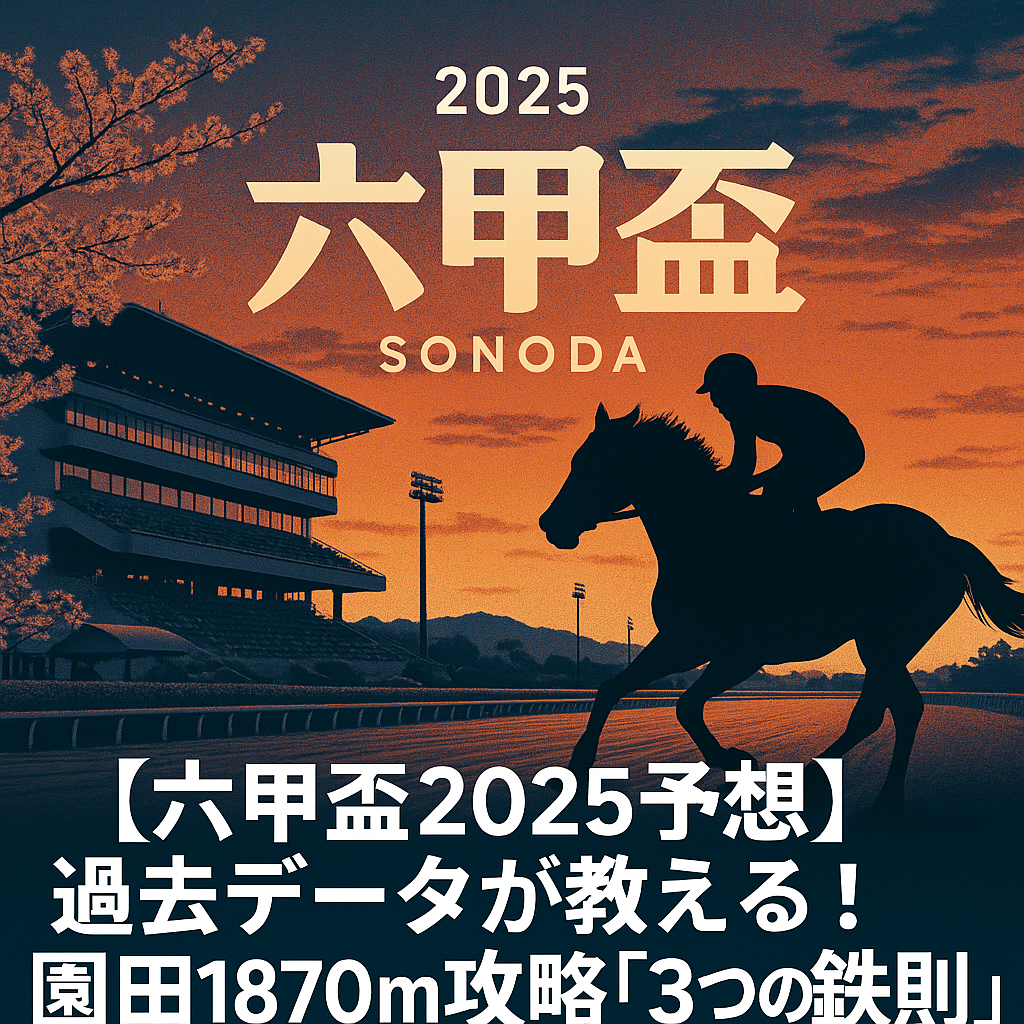
The prestigious Rokkō Hai, a long-standing Grade Race held at Sonoda Racecourse, annually captivates horse racing enthusiasts. Serving as a crucial indicator for the spring’s older horse middle-to-long distance circuit, the 2025 edition is set to deliver thrilling competition over 1870m on Thursday, June 5th.
This article provides an in-depth analysis and explanation of ‘3 Key Prediction Points’ to conquer this historic Rokkō Hai. We’ll focus on past race trends, particularly data from 2024 onwards, when the distance was changed to the current 1870m, guiding you towards successful predictions.
Throughout its rich history, the Rokkō Hai has seen multiple changes in its host racecourse and distance. Notably, after being shortened to 1870m in 2000, it was run over 2400m for an extended period from 2007, before reverting to 1870m in 2024. This ‘distance’ factor is arguably one of the most critical keys for predicting modern Rokkō Hai outcomes. This significant distance alteration profoundly impacts the race’s characteristics. When comparing data from the previous 2400m era with the current 1870m setup, it’s crucial to acknowledge these distinctions. The change suggests that adaptability to the 1870m distance is now paramount, moving beyond just class levels or previous success at Sonoda.
Watch the video analysis here:
スポンサーリンク
Rokkō Hai 2025 Race Overview & Sonoda 1870m Course Analysis
Race Overview
- Date: Thursday, June 5, 2025 (令和7年6月5日(木))
- Venue: Sonoda Racecourse (園田競馬場)
- Distance: 1,870m
- Eligibility: Thoroughbred, 4 years old and up (サラ系4歳以上)
- First Prize Money: 10 million yen (1,000万円)
- Weights: Set weights: Colts & Geldings 57kg, Fillies & Mares 55kg (定量 牡・騙 57㎏ 牝 55㎏)
Sonoda 1870m Course Characteristics
The Sonoda Racecourse 1870m course is renowned as one of the most challenging layouts in local horse racing. A key feature is its remarkably short home straight, measuring just 213m. This brevity makes late charges from the rear highly difficult, significantly influencing race dynamics and often favoring front-runners.
Consequently, with a minimal straight and a high proportion of turns throughout the course, horses that can navigate the inside rail efficiently and maintain a forward position tend to gain a significant advantage. The tight turns and compact nature of the track demand agility and skillful maneuvering from both horse and jockey.
Furthermore, a challenging 1.23m elevation change on the backstretch leading into the third corner is a critical factor. The jockey’s decision on how to navigate this incline and precisely when to initiate a surge can decisively sway the outcome. This hill demands not only stamina but also a sudden burst of acceleration at a crucial point, truly testing a jockey’s skill and strategic acumen.
Adding to its uniqueness, unlike typical racecourses, the backstretch at Sonoda isn’t a perfect straight but features a gentle right-hand curve. This makes managing a horse’s breath and securing optimal track position even more challenging, often leading to a tightly packed field. These combined elements transform the Sonoda 1870m into a stage where not just pure speed, but a horse’s tractability, a jockey’s course management, and their pace judgment are paramount. It’s a highly tactical course where a moment’s lapse or misjudgment can prove fatal.
スポンサーリンク
Rokkō Hai 2025: In-Depth Data Analysis & 3 Key Prediction Points
Point 1: Distance Change is Key! Mastering the 1870m and Track Tendencies
In 2024, the Rokkō Hai underwent a significant distance reduction, moving from the long-standing 2400m to 1870m – a substantial cut of approximately 530m. This change drastically altered the race pace, the required balance of stamina and speed, and overall racing tactics. Consequently, for the 2025 predictions, adaptability to this 1870m distance stands as the single most critical factor.
The 2024 race, serving as a crucial test case, saw the second-favorite Lucky Dream (ridden by Osamu Shimohara, trained by Masashi Shinji) secure a front-running victory. Despite starting from the wide 8th gate (post 11), Lucky Dream grabbed the lead with an impeccable start and held off all challengers to win wire-to-wire. This triumph not only reinforced the prevailing theory of inner gate and front-runner advantage on the Sonoda 1870m course but also demonstrated that with exceptional gate speed, an impressive burst from the start, and the ability to control the pace throughout, even an outer draw can lead to victory. Lucky Dream maintained the lead from the first corner, delivering a dominant performance.
In the same 2024 race, the top favorite, Seika Meteopolis (Ohi affiliation), faded from midfield to finish 7th. Conversely, Your History (Funabashi affiliation), the 5th favorite, took second place, and Tsumu Taizan (Hyogo affiliation), an 8th favorite, secured third, leading to a substantial Trifecta payout of 82,210 yen. This unpredictable outcome highlights that specialized adaptability to the 1870m distance, along with favorable race dynamics on the day, are far more crucial than past 2400m achievements or simple popularity. The shortened distance likely emphasized sustained speed and strategic positioning, contributing to the upset.
While data exists from previous periods when the Rokkō Hai was run over 1870m (2000-2003; noting 2000 was a 3-year-old race, and from 2001, it became a Tokai/Hokuriku/Kinki inter-regional race, with the 2004 edition at Himeji over 2000m), it’s important to recognize that track conditions, field quality, weight regulations, and especially equine bloodlines and training techniques have evolved significantly. Therefore, directly applying this older data to modern race predictions is challenging; it should be considered for reference only. The core of your 2025 prediction strategy should firmly rest on the 2024 race’s content and results. As the only sample under the current conditions, the insights gleaned from the 2024 Rokkō Hai are the most valuable information for forecasting the upcoming race.
スポンサーリンク
Rokkō Hai 1870m Recent Race Results and Key Data
| Year | Winner | Sex/Age | Gate | Post No. | Jockey | Trainer | Odds | Time | 2nd Place Horse | 1st Favorite’s Finish | Winner’s Cornering Order (1C-2C-3C-4C) |
|---|---|---|---|---|---|---|---|---|---|---|---|
| 2024 | Lucky Dream | C6 | 8 | 11 | Osamu Shimohara | Masashi Shinji | 2 | 2:03.1 | Your History | 7th | 1-1-1-1 |
| 2003 | Hokuzan Field | C4 | Tokuhiko Hiramatsu | Tadao Hashimoto | 2:01.9 | ||||||
| 2002 | Road Bakushin | C4 | Futoshi Komaki | Naoshige Sowa | 2:00.9 | ||||||
| 2000 | Special Dash | C3 | Kotaro Akagi | Takashi Saito | 2:05.0 |
This table clearly highlights Lucky Dream’s dominant wire-to-wire victory in 2024. It strongly suggests that for the 1870m distance, securing an early, favorable position and seizing control of the race are paramount.
Point 2: Focus on Jockey and Trainer Expertise: Identifying Sonoda Specialists
Given its unique course configuration, Sonoda Racecourse places immense importance on the skill of jockeys who intimately know the track and the conditioning prowess of trainers who expertly prepare their horses for local conditions and race dynamics. Thus, identifying horse-and-rider combinations that are ‘Sonoda Specialists’—more than just highly capable horses—is a crucial element in handicapping the Rokkō Hai.
Jockey Osamu Shimohara, who piloted Lucky Dream to victory in the 2024 Rokkō Hai, has an exceptional affinity for this race. He has secured multiple Rokkō Hai titles on various horses and across different distances (including during the 2400m era), notably with Tagano Gold (winning twice in March and June 2019), Tosen Bull (2021), and Erimo Araluma (2013). Shimohara is truly a ‘Rokkō Hai Maestro.’ Trainer Masashi Shinji, who managed Lucky Dream, also boasts an impressive record in this race, including Tagano Gold’s back-to-back spring and autumn victories. The consistent success of such jockeys and trainers in specific races is not mere coincidence but a testament to their profound understanding and meticulous preparation for that particular event.
A review of past Rokkō Hai winners consistently shows the prominence of local Hyogo-affiliated jockeys and trainers. Their daily training and racing experience at Sonoda give them an intimate understanding of the track’s unique characteristics. However, challengers from other regions should not be underestimated. Notable examples include Your History (Funabashi, trained by Takayuki Yamashita, ridden by Tatsuya Sawada) who finished second in 2024, Greed Parfait (Kochi, trained by Mamoru Tanaka, ridden by Shuji Akaoka) who won in 2023, and Akkie (Kawasaki, trained by Takayuki Hayashi, ridden by Takashi Nakata) who triumphed in 2020. These successes often stem from the horses’ high inherent ability combined with jockeys who either have extensive prior experience at the track or demonstrate exceptional skill in adapting on their first ride.
The timing of a move on the incline leading into the crucial third corner of the Sonoda 1870m, and the ensuing drive down the short straight, are prime moments where a jockey’s experience and judgment are truly put to the test. Therefore, when formulating your predictions, it’s vital to consider the ‘human’ element: top-ranking jockeys, those with proven track records in Sonoda’s longer races (while 1870m is classified as middle-distance, it’s relatively long for Sonoda), and how the horses’ affiliated stables have prepared them specifically for this event.
スポンサーリンク
Point 3: Assessing Favorite Reliability, Age, and Gate Position Advantages
When handicapping the Rokkō Hai, the reliability of favorites, the age composition of the field, and the unique gate position advantages and disadvantages at Sonoda are all crucial, interconnected factors to consider.
Reliability of Favorites
The Rokkō Hai is not a race where the top favorite is a guaranteed winner. In 2024, the favored Seika Meteopolis finished 7th, while the second-favorite Lucky Dream secured victory. Similarly, in 2023, the top favorite Lucky Dream placed second, with the win going to the second-favorite Greed Parfait. However, 2022 saw the favorite Jingi claim a straightforward victory. Looking further back, Tosen Bull, the second favorite, won in 2021, and Akkie, a fifth favorite, triumphed in 2020, underscoring the constant potential for moderate upsets. The data reveals that over the past five years (2020-2024), the favorite has won only once (in 2022). This statistic cautions against placing excessive trust in the top-fancied horse and highlights the value of seeking out horses ranked second or third, or even less popular contenders with strong suitability for the conditions.
Age Composition
Recent winners show a clear trend: Lucky Dream (6-year-old in 2024), Greed Parfait (7-year-old in 2023), Jingi (6-year-old in 2022), Tosen Bull (6-year-old in 2021), and Akkie (7-year-old mare in 2020). This consistently indicates that experienced horses aged five and above dominate. While 4-year-olds are eligible, success in this race appears to demand the seasoned experience necessary to conquer Sonoda’s challenging course and the delicate balance of stamina and speed required for the 1870m distance. It’s a stage where the enduring strength and skillful race management of veteran horses shine, often proving too tough for younger, less experienced contenders relying solely on raw power.
Gate Position Advantages and Disadvantages
While Sonoda Racecourse is generally considered favorable for inner gate draws, recent Rokkō Hai results don’t always adhere to this theory. Winners in recent years include Lucky Dream from gate 8 (post 11) in 2024, Greed Parfait from gate 7 (post 9) in 2023, and Jingi from gate 6 (post 6) in 2022, highlighting significant success from middle to outer gates. This suggests, as exemplified by Lucky Dream’s impeccable start to seize the lead, that race dynamics, a horse’s gate aptitude, and its ability to secure an optimal position after the start can more than compensate for any perceived gate disadvantage. Of course, Akkie’s victory from gate 1 (post 1) in 2020 shows that inner gates can also be maximized. The crucial aspect is not merely the gate number itself, but a thorough consideration of how a horse is likely to run from that position, and what ideal track position it can achieve within the specific field composition. For instance, one must assess the risk of outer gate front-runners being boxed in if many horses want to lead, or conversely, the danger of an inner gate horse getting caught in traffic due to a slow start or uncooperative pace. A nuanced understanding of the likely race flow is paramount for accurate gate assessment.
 最新レース予想
 最新レース予想
 最新レース予想
 最新レース予想